
Immigrating to Canada? Here’s How Dual Citizenship Works

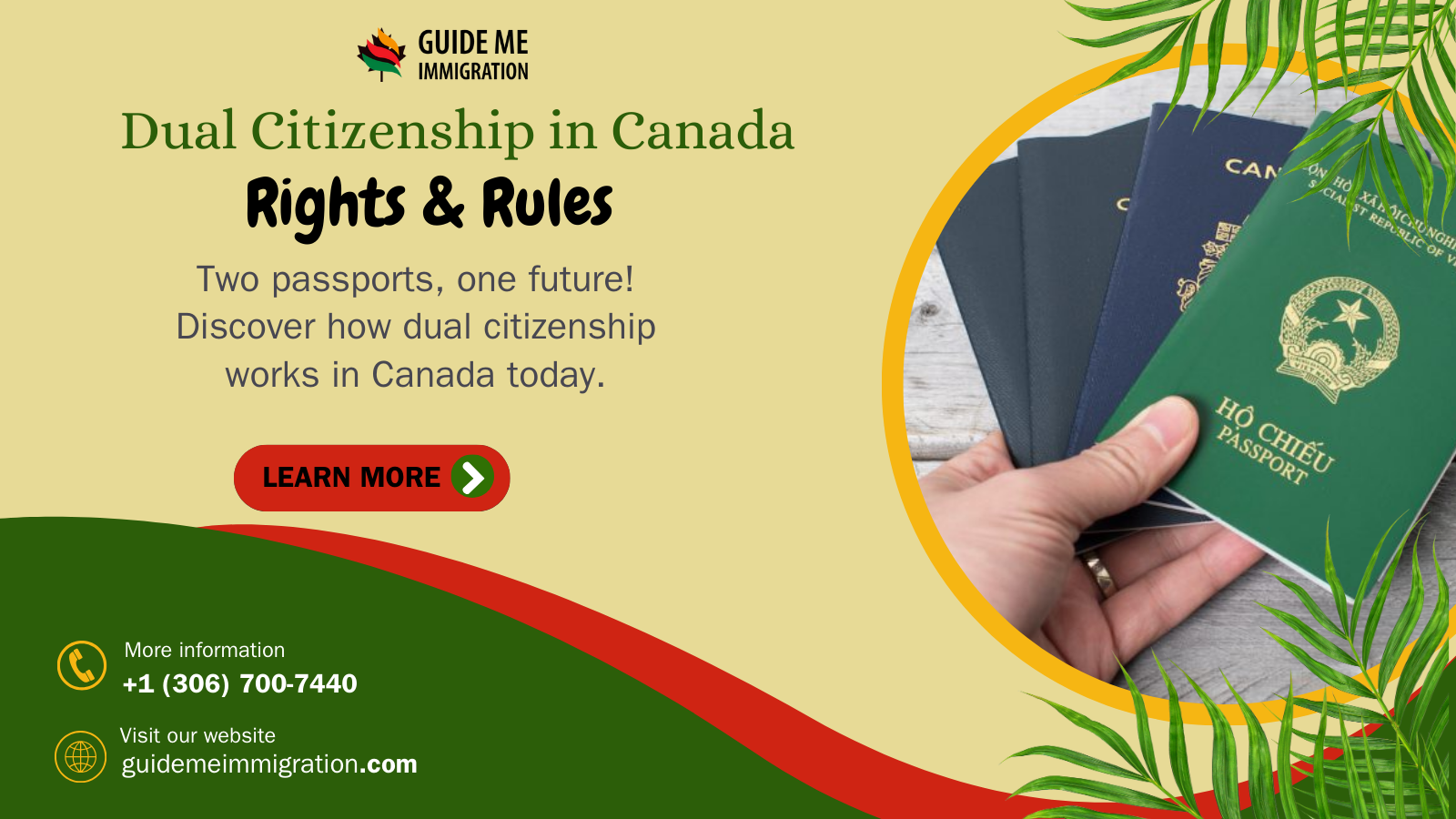
Two passports representing dual citizenship, including a Canadian passport, placed on a table

Can You Be a Dual Citizen if You Immigrate to Canada? Everything You Need to Know

Immigrating to Canada is an exciting journey filled with opportunities for a better life. For many, one of the big questions is whether Canada allows dual citizenship. The answer is yes, and this possibility can significantly enhance your migration experience. In this comprehensive guide, we’ll explore everything about dual citizenship, including its benefits, legal considerations, and how to navigate the process effectively.


Table of Contents

  1. What Is Dual Citizenship?
  2. Canada’s Approach to Dual Citizenship
  3. Benefits of Dual Citizenship in Canada
  4. Understanding Your Home Country’s Policies
  5. Eligibility for Canadian Citizenship
  6. The Path to Dual Citizenship
  7. Common Challenges and How to Overcome Them
  8. FAQs About Dual Citizenship in Canada
  9. How Guide Me Immigration Can Help

1. What Is Dual Citizenship?

Dual citizenship means being a legal citizen of two countries at the same time. As a dual citizen, you hold two passports and enjoy the rights and responsibilities of both nations. However, the rules surrounding dual citizenship vary depending on each country’s laws.

For instance, while Canada allows dual citizenship, some countries require you to renounce your original citizenship when acquiring a new one. Understanding the legal framework is key before proceeding.


2. Canada’s Approach to Dual Citizenship

Canada has a progressive stance on dual citizenship. Since 1977, the Canadian government has allowed individuals to acquire Canadian citizenship without renouncing their original nationality. This flexibility is one of the reasons Canada is a popular destination for immigrants worldwide.

However, your ability to hold dual citizenship also depends on your home country. Some nations, such as India and China, do not permit dual citizenship, while others, like the United States and the United Kingdom, do.


3. Benefits of Dual Citizenship in Canada

Dual citizenship comes with numerous advantages, making it a valuable status for those who qualify.

A. Access to Canadian Benefits

As a Canadian citizen, you gain access to:

  • Universal Healthcare: Benefit from Canada’s publicly funded healthcare system.
  • Social Programs: Access programs like pensions, unemployment insurance, and child benefits.
  • Educational Opportunities: Enjoy lower tuition fees for Canadian universities and colleges.

B. Travel Freedom

A Canadian passport ranks among the strongest globally, offering visa-free or visa-on-arrival access to over 185 countries. This mobility is especially beneficial for business, leisure, or family visits.

C. Retaining Your Heritage

Dual citizenship allows you to maintain strong ties with your home country, preserving your cultural identity and family connections while enjoying life in Canada.


4. Understanding Your Home Country’s Policies

While Canada allows dual citizenship, it’s crucial to check your home country’s laws. Here’s a breakdown:

  • Countries That Allow Dual Citizenship: United States, United Kingdom, Australia, and many European nations.
  • Countries That Restrict Dual Citizenship: India, China, and Japan, among others, may not recognize or permit dual citizenship.

If your home country doesn’t allow dual citizenship, you may face challenges like losing your original citizenship upon becoming Canadian.


5. Eligibility for Canadian Citizenship

Before pursuing dual citizenship, you must first qualify for Canadian citizenship. The main eligibility criteria include:

  • Permanent Residency: You must hold permanent resident (PR) status in Canada.
  • Physical Presence: You need to have lived in Canada for at least 1,095 days (three years) out of the last five years.
  • Language Proficiency: Demonstrate basic knowledge of English or French.
  • No Criminal Record: Ensure a clean legal record.

6. The Path to Dual Citizenship

A. Becoming a Permanent Resident

Your journey starts with acquiring permanent residency through pathways like Express Entry, Provincial Nominee Programs (PNPs), or family sponsorship.

B. Meeting Citizenship Requirements

As a PR, fulfill the eligibility criteria, including the physical presence requirement and filing taxes in Canada for at least three years.

C. Applying for Canadian Citizenship

Submit your citizenship application along with supporting documents, pay the required fees, and pass the citizenship test and interview.

D. Swearing the Oath of Citizenship

Once approved, attend a citizenship ceremony where you’ll take the Oath of Citizenship and officially become a Canadian citizen.


7. Common Challenges and How to Overcome Them

A. Home Country Restrictions

If your home country doesn’t allow dual citizenship, consider these options:

  • Explore “Overseas Citizenship” or similar programs, if available.
  • Consult with legal experts to understand the implications.

B. Meeting Physical Presence Requirements

Track your days in Canada using tools like the Physical Presence Calculator on the IRCC website.

C. Navigating Complex Paperwork

Ensure your documents are complete and accurate to avoid delays. Seeking professional guidance can help.


8. FAQs About Dual Citizenship in Canada

Q1: Can I lose Canadian citizenship if my home country doesn’t allow dual citizenship?

No, Canada does not revoke citizenship based on another country’s policies. However, your home country may choose to revoke your original citizenship.

Q2: Do dual citizens pay taxes in both countries?

Tax obligations depend on treaties between Canada and your home country. Some countries have agreements to prevent double taxation.

Q3: Is dual citizenship automatic for children born in Canada to foreign parents?

Children born in Canada automatically gain Canadian citizenship. If your home country allows dual citizenship, they may hold both.


9. How Guide Me Immigration Can Help

Navigating the path to dual citizenship can be complex, but you don’t have to do it alone. At Guide Me Immigration, we specialize in simplifying the process for you.

Why Choose Us?

  • Expertise in Canadian immigration laws.
  • Personalized guidance tailored to your unique situation.
  • Offices conveniently located in Saskatoon and Regina for in-person consultations.

Contact Us Today!

📍 Saskatoon Office: 535 20th St West, Saskatoon, SK S7M 0X6 (Unit-C)
📍 Regina Office: Unit 170 – 2410 Dewdney Ave, Regina, SK S4R 1H6
📞 Call Us: +1 306 700 7440


Dual citizenship opens the door to endless opportunities, allowing you to enjoy the best of two worlds. If you’re ready to start your journey, reach out to Guide Me Immigration, and let us help you achieve your dreams.

Our Website:https://guidemeimmigration.com/

Other Link:http://canesl.ca

Facebook
Twitter
LinkedIn

More Posts

Proof of Canadian citizenship wait time hits 35 months as queue reaches a record high author avatar Janice Rodrigues Immigration, Refugees and Citizenship Canada (IRCC) updated its processing times tool for proof of citizenship applications on November 17. The new estimate adds one month to October's figure of 34 months. The line of applicants awaiting an IRCC decision grew again. IRCC now counts about 139,200 people. That's 8,500 more than in October, an increase of about 6.5%. The new total is the largest queue IRCC has reported since Canada changed its citizenship law in December 2025. Get a Free Consultation on Applying for Proof of Canadian Citizenship At today's estimate, a person who applies this week could expect a decision on their citizenship by descent application around October 2029. Wait times rose by one month for the second update in a row From May through September, every monthly increase was bigger than the one before it. September's update added eight months. October broke that pattern with a one-month rise. November matched it. Reading Quoted wait Increase Month-over-month change May 2026 12 months +2 months 20.0% June 2026 15 months +3 months 25.0% July 2026 19 months +4 months 26.7% August 2026 25 months +6 months 31.6% September 2026 33 months +8 months 32.0% October 2026 34 months +1 month 3.0% November 2026 35 months +1 month 2.9% Month-over-month changes are CIC News calculations based on IRCC's processing times tool. The wait is still climbing, but more slowly than in the summer. The queue is growing again after October's drop Last month, IRCC reported 130,700 people waiting for a decision on their proof of citizenship application. That was 5,300 fewer than in September, and the first drop since the law changed. November's figure shows the queue growing again, past September's previous high of 136,000. Since December 2025, the queue has grown from about 40,400 people to 139,200. That's more than three times its size when Bill C-3 took effect. The rise comes even as IRCC's output has picked up. The department finalized 5,705 proof of citizenship applications in September, according to CIC News calculations based on IRCC data published November 17. That was its highest monthly total since IRCC began publishing a monthly breakdown in June. Canadian citizenship by descent applications take 35 months to process as of November 2026 Processing times for a proof of citizenship application have grown, month on month Applying from outside Canada or the U.S. The 35-month figure applies to applications filed in Canada and the U.S. IRCC warns that applications from other countries may take longer. For those applicants, IRCC advises allowing an extra three to four months for mail. Some applicants abroad use a representative in Canada to cut that time. Check Your Eligibility for Canadian Citizenship Who these wait times affect A proof of citizenship application is how a person who is already Canadian gets a citizenship certificate. The certificate is the document that confirms their status. The queue includes people replacing a lost certificate. But most of its growth this year has come from Canadians by descent, who were born outside Canada to a Canadian parent or ancestor. On December 15, 2025, Bill C-3 removed the first-generation limit for anyone born before that date. The first-generation limit previously stopped Canadian parents born abroad from passing citizenship to children also born abroad. Without that limit, a person born before December 15, 2025, with an unbroken line to a Canadian ancestor can be a Canadian citizen too. The number of generations in between no longer matters. Many of the new applicants are Americans with Canadian roots. A certificate lets them apply for a Canadian passport. Can I get my certificate sooner? IRCC can move some files ahead of the queue through urgent processing. It decides each request on its own facts. Reasons IRCC accepts include: A job you're applying for A place at a school, college, or university Travel because of a death or serious illness in the family Access to a pension, health care, or a social insurance number A request needs a letter explaining why you need the certificate sooner. It also needs a document showing the date involved, such as an employer's letter or a plane ticket. Meeting the criteria doesn't guarantee that IRCC will speed up your file. You can see how IRCC handled urgent requests in the law's first eight months. An immigration lawyer can tell you whether your case is likely to qualify. Should I wait to apply? Waiting won't shorten your wait. IRCC places each new file behind every application already in the queue. This month, that queue grew by 8,500 people. Anyone who holds off joins the line behind them. A complete application matters as much as timing. Missing records or name mismatches across generations can lead IRCC to ask for more documents or return applications, which adds months to the processing time. Am I a Canadian citizen? You may already be Canadian if you were born before December 15, 2025 and have an unbroken line to a Canadian ancestor. This includes a Canadian grandparent, a great-grandparent, or a more distant ancestor. Where you were born doesn't matter. Neither does whether your parents ever lived in Canada. If you are unsure whether you qualify, CanadaVisa has a free eligibility checker that can help you check if you are eligible for Canadian citizenship by descent.

Proof of Canadian citizenship wait time hits 35 months as queue reaches a record high author avatar Janice Rodrigues Immigration, Refugees and Citizenship Canada (IRCC) updated its processing times tool for proof of citizenship applications on November 17. The new estimate adds one month to October’s figure of 34 months. The line of applicants awaiting an IRCC decision grew again. IRCC now counts about 139,200 people. That’s 8,500 more than in October, an increase of about 6.5%. The new total is the largest queue IRCC has reported since Canada changed its citizenship law in December 2025. Get a Free Consultation on Applying for Proof of Canadian Citizenship At today’s estimate, a person who applies this week could expect a decision on their citizenship by descent application around October 2029. Wait times rose by one month for the second update in a row From May through September, every monthly increase was bigger than the one before it. September’s update added eight months. October broke that pattern with a one-month rise. November matched it. Reading Quoted wait Increase Month-over-month change May 2026 12 months +2 months 20.0% June 2026 15 months +3 months 25.0% July 2026 19 months +4 months 26.7% August 2026 25 months +6 months 31.6% September 2026 33 months +8 months 32.0% October 2026 34 months +1 month 3.0% November 2026 35 months +1 month 2.9% Month-over-month changes are CIC News calculations based on IRCC’s processing times tool. The wait is still climbing, but more slowly than in the summer. The queue is growing again after October’s drop Last month, IRCC reported 130,700 people waiting for a decision on their proof of citizenship application. That was 5,300 fewer than in September, and the first drop since the law changed. November’s figure shows the queue growing again, past September’s previous high of 136,000. Since December 2025, the queue has grown from about 40,400 people to 139,200. That’s more than three times its size when Bill C-3 took effect. The rise comes even as IRCC’s output has picked up. The department finalized 5,705 proof of citizenship applications in September, according to CIC News calculations based on IRCC data published November 17. That was its highest monthly total since IRCC began publishing a monthly breakdown in June. Canadian citizenship by descent applications take 35 months to process as of November 2026 Processing times for a proof of citizenship application have grown, month on month Applying from outside Canada or the U.S. The 35-month figure applies to applications filed in Canada and the U.S. IRCC warns that applications from other countries may take longer. For those applicants, IRCC advises allowing an extra three to four months for mail. Some applicants abroad use a representative in Canada to cut that time. Check Your Eligibility for Canadian Citizenship Who these wait times affect A proof of citizenship application is how a person who is already Canadian gets a citizenship certificate. The certificate is the document that confirms their status. The queue includes people replacing a lost certificate. But most of its growth this year has come from Canadians by descent, who were born outside Canada to a Canadian parent or ancestor. On December 15, 2025, Bill C-3 removed the first-generation limit for anyone born before that date. The first-generation limit previously stopped Canadian parents born abroad from passing citizenship to children also born abroad. Without that limit, a person born before December 15, 2025, with an unbroken line to a Canadian ancestor can be a Canadian citizen too. The number of generations in between no longer matters. Many of the new applicants are Americans with Canadian roots. A certificate lets them apply for a Canadian passport. Can I get my certificate sooner? IRCC can move some files ahead of the queue through urgent processing. It decides each request on its own facts. Reasons IRCC accepts include: A job you’re applying for A place at a school, college, or university Travel because of a death or serious illness in the family Access to a pension, health care, or a social insurance number A request needs a letter explaining why you need the certificate sooner. It also needs a document showing the date involved, such as an employer’s letter or a plane ticket. Meeting the criteria doesn’t guarantee that IRCC will speed up your file. You can see how IRCC handled urgent requests in the law’s first eight months. An immigration lawyer can tell you whether your case is likely to qualify. Should I wait to apply? Waiting won’t shorten your wait. IRCC places each new file behind every application already in the queue. This month, that queue grew by 8,500 people. Anyone who holds off joins the line behind them. A complete application matters as much as timing. Missing records or name mismatches across generations can lead IRCC to ask for more documents or return applications, which adds months to the processing time. Am I a Canadian citizen? You may already be Canadian if you were born before December 15, 2025 and have an unbroken line to a Canadian ancestor. This includes a Canadian grandparent, a great-grandparent, or a more distant ancestor. Where you were born doesn’t matter. Neither does whether your parents ever lived in Canada. If you are unsure whether you qualify, CanadaVisa has a free eligibility checker that can help you check if you are eligible for Canadian citizenship by descent.

Send Us A Message